
Climate transition plan
The next step is calculating the organization's carbon footprint. At a time when the world faces increasing climate challenges, the Climate Transition Plan (CTP) is becoming a strategic document for organizations that want to successfully navigate the path to sustainable business. This plan is not just a formal requirement prescribed by the Corporate Sustainability Reporting Directive (CSRD) and European Sustainability Reporting Standard E1 (ESRS E1), but represents a comprehensive framework for transforming business in line with the goals of the Paris Agreement.
Why is a transition plan important?
A transition plan enables organizations to systematically reduce their environmental impact and adapt to climate change. It is a strategic plan that aligns business goals with climate ambitions and ensures:
- Clear direction for decarbonizing operations
- Transparency and accountability to stakeholders
- Compliance with climate legislation and regulatory requirements
- Preparedness for future market conditions where carbon intensity will be an important competitive factor
- Attractiveness to investors who increasingly value sustainability-oriented organizations
Setting science-based goals
Setting targets is the first step in developing a transition plan. Organizations need to set science-based greenhouse gas emission reduction targets that are aligned with the global goal of limiting warming to 1.5°C.
This requires:
- Accurate understanding of current carbon footprint across all three CO₂ emission scales
- Setting short-term goals for 2030
- Definition of intermediate five-year goals until 2050
- Ensuring long-term focus and traceability of progress
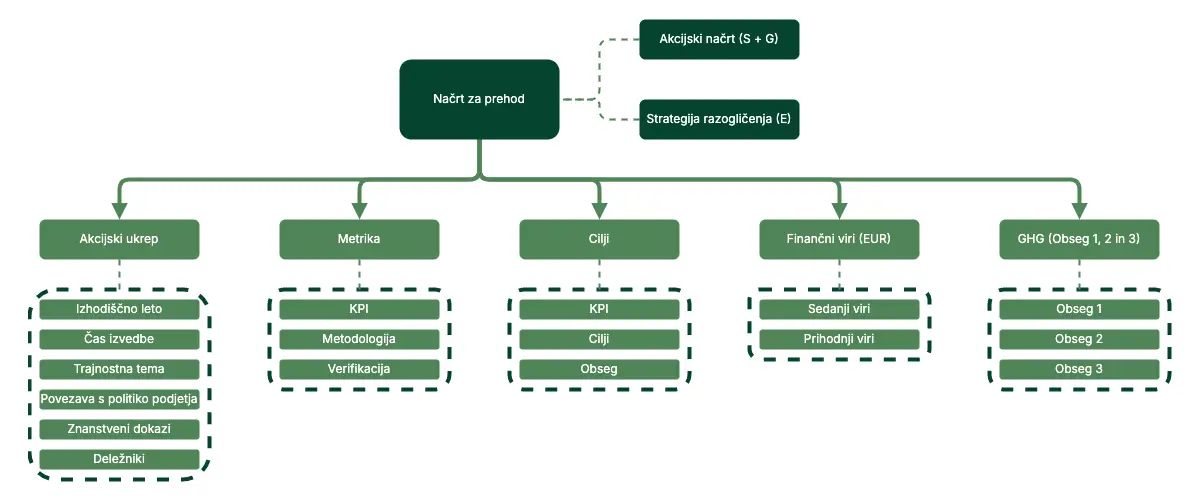
Levers and measures for implementation
To achieve the set goals, organizations must develop concrete measures within the framework of a transition plan, ranging from technological improvements to fundamental changes in business models and processes.
These include:
- Transition to renewable energy sources
- Improving energy efficiency
- Development of more environmentally friendly products and services
- Deeper collaboration with suppliers and other partners in the value chain
- Logistics and transport optimization
- Electrification of the rolling stock
Particular attention should be paid to the financing of these measures, with organisations having to align their investment plans with the criteria of the European taxonomy for sustainable activities.
Linking the transition plan to the EU taxonomy
The transition plan must be closely linked to the EU taxonomy, a classification system for sustainable economic activities. Organisations must transparently report on their investments in high-emission sectors and explain how they intend to align their capital and operational expenditure with the taxonomy's climate criteria.
This coordination is key to:
- Access to green finance
- Demonstrating the seriousness of the organization's commitments to a sustainable transition
- Meeting the requirements of investors and regulators
- Reducing the risk of accusations of greenwashing
Methodological approach for preparing a transition plan
When preparing an effective transition plan, organizations can use different methodological approaches:
1. Scenario analysis
Enables organizations to explore potential climate pathways and their impact on business
2. Analysis of climate risks and opportunities
Identifies key risks and opportunities related to climate change
3. Emissions value chain
Provides a holistic understanding of emissions across an organization's entire value chain
4. Life cycle analysis
Provides insight into the environmental impacts of products or services throughout their entire life cycle
ESG ON provides comprehensive support to organizations in this process with its integrated set of tools and methodologies. This includes a structured approach to identifying appropriate levers and actions, as well as a clear methodology for preparing the final transition plan document. The process is supported by an AI assistant that facilitates data collection and analysis, as well as the preparation of relevant reports.
To subscribe to the application or get help with module selection, please fill out the form below.
Not sure which module to choose? Or are you only interested in a specific module?
Contact us and we will advise you.